
 GER
GER  EST
EST Regio – Spatial Data Experts for over 30 years
Regio stands out in the field of spatial data creation and processing thanks to:
- Extensive experience—We’ve been operating since 1994, continuously optimizing our technologies and workflows.
- Broad expertise—We collect, manage, and process spatial data for a wide range of fields: cartography, web maps, logistics, planning, mobile services, and more.
- End-to-end solutions—We offer complete services for processing data and map design.
We help organizations and businesses analyze complex geographic data and extract valuable information. Our solutions help optimize business processes and enable more informed decision-making.
Regio’s services are trusted by the public sector, emergency services, construction and real estate companies, banks, logistics providers, tourism businesses, IT companies, and many others.
Efficient planning of fiber optic networks requires accurate spatial data, skilled data creation and cleaning, proper documentation, and regular data updates.
Identifying suitable areas for solar and wind energy installations requires analysis of various spatial data layers, including restrictions, land cover characteristics, accessibility, and environmental conditions.
Regio has over a decade of experience in creating accurate spatial databases tailored to the needs of the military and security sector. We offer satellite image digitization, change detection analysis, and the production of topographic maps and geospatial datasets – supporting strategic planning and operational readiness.
We help create a structured and efficient metadata management system that enables quick access, easy administration, and knowledge sharing. A wiki-style solution supports documentation, smooth processes, and the retention of expert knowledge, making information within the organization easily discoverable and manageable.
Geospatial Data Creation
Accurate and high quality data for better decision-making
Creation of geospatial data is the foundation of geographic information systems (GIS), planning, and data analysis. Regio offers a wide range of services for generating, digitizing, and customizing spatial data to meet the diverse needs of users.
Our extensive experience and precise data support both public sector and private companies, helping to improve decision-making, logistics, planning, and infrastructure development.

Vector data digitization
We create precise spatial data based on satellite imagery, orthophotos, and raster maps, ensuring suitability for client needs.
Collection of detailed spatial data
Our team gathers and processes spatially accurate and attribute-rich data that meets even the most demanding requirements.
Data discovery and standardization
We help find, integrate, and adapt different datasets to ensure a unified format and easy usability.
Custom solutions for enterprises
We provide tailored spatial data creation solutions, supporting your GIS department with professional assistance and reducing time pressure caused by workforce shortages.
Regio provides high-quality and accurate spatial data that help companies and institutions work more efficiently, make better decisions, and offer better services.
- Logistics and transport—route optimization, supply chain management, and operational efficiency improvement.
- Construction and real estate—smarter planning, real estate development optimization, and infrastructure management.
- Energy sector and utilities—network planning, resource management, and improvement of emergency operations.
- Banking and insurance—risk analysis, market segment evaluation, and customer behavior analysis.
- Public sector and emergency services—accurate maps, crisis management, and faster decision-making.
- Agriculture and forestry—yield monitoring, smart farming, and forest resource management.
- Telecommunications—metwork coverage planning and infrastructure optimization.
- Defence and security—operational maps, crisis coordination, and strategic planning.
- Tourism and leisure—interactive maps, route planning, and POI management.
- Healthcare and medical services—optimizing hospital and ambulance services, epidemiological mapping.
- Mining and geology—resource mapping, risk analysis, and environmental impact assessments.
- E-Commerce and retail—supply chain optimization, location-based marketing, and customer analytics.
- Environmental protection and sustainability—environmental monitoring, green space planning, and climate change analysis.
The company needed precisely outlined objects related to its area of interest, along with various attributes assigned to them. We created a detailed digital twin enriched with attribute data based on the client’s specifications.
The company needed road and street navigation data to optimize its delivery routes for use in its logistics software. We customized our road and navigation database to meet the client’s software specifications.
The company needed rapid large-scale geo-data digitization and database creation, but was short on internal resources. We assisted with the database setup and vectorization tasks.
Geospatial Data Processing
Structured and accurate data for efficient use
Processing of spatial is essential to ensure the quality, compatibility, and usability of data across different systems. Regio’s specialists organize and refine data, making it easy to use in GIS systems, business analysis, and planning processes.
During processing, data is cleaned, classified, and standardized, enabling seamless integration into various information systems and supporting strategic decision-making.
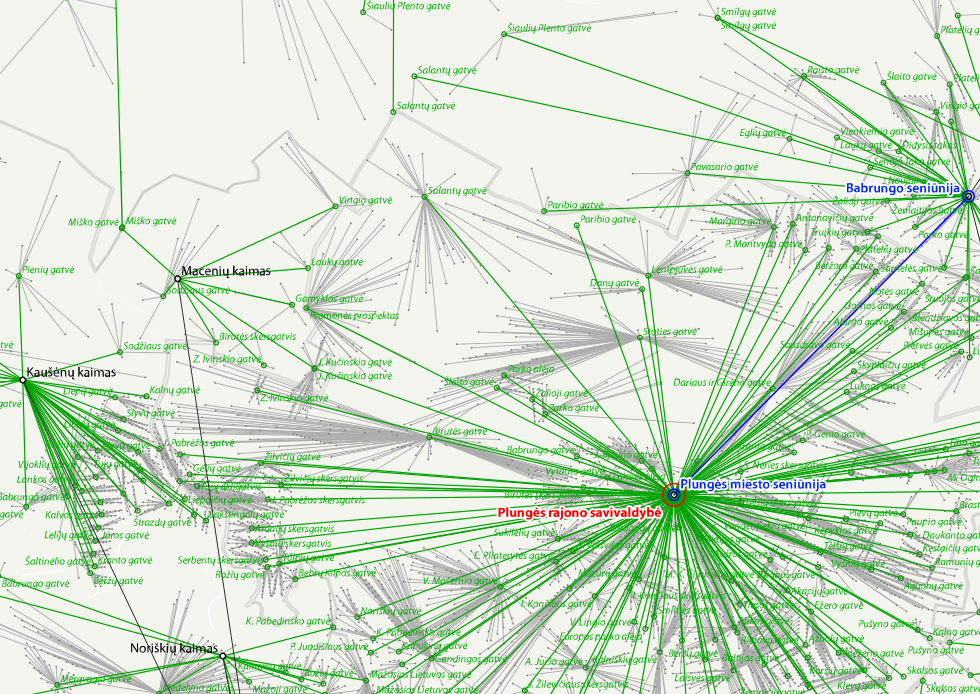
Data systematization and cleaning
We clean data, remove duplicates, and improve quality based on client requirements.
Georeferencing and geometry processing
Ensuring that data fits into map applications and GIS systems.
Linking and standardizing tabular data
We integrate spatial data from various sources to ensure a unified format and improved usability.
Data transformation
We format and structure datasets into map layers, tables, or other practical solutions.
Processing of geospatial data ensures high-quality, compatible, and easily usable data, supporting more efficient decision-making and planning.
Structured datasets enable seamless integration into GIS systems, business intelligence tools, and various software solutions.
Accurate and standardized data reduces the risk of errors, optimizes workflows, and helps achieve strategic goals.
GIS Solutions and
Data Management
Modern GIS tools, especially QGIS, help organizations manage and analyze spatial data and databases, optimize workflows, and support more accurate, data-driven decisions. Well-structured data management, optimized databases, and professionally developed GIS solutions ensure that decisions are based on high-quality and up-to-date data.
Regio supports the adoption of QGIS, geospatial data and database processing, data migration, and the development of GIS solutions, providing practical expertise and specialist support throughout.

QGIS training and adoption
We support the implementation of open-source GIS software—QGIS—provide hands-on training, and design training programs tailored to your needs. We cover core skills as well as advanced analyses, QGIS project structure, workflow automation, and best practices.
GIS solutions development and automation
We develop custom QGIS plugins, PostGIS-based data processing procedures, and other geospatial automation solutions that make large-scale and repetitive tasks fast, reliable, and efficient.
Database management and migration
We migrate outdated or fragmented datasets to modern solutions and create optimized PostgreSQL/PostGIS databases. We deliver data management solutions tailored to your specific requirements.
GIS consulting
We provide consulting on open-source GIS systems, coordinate systems (L-EST97, WGS-84), and geometry formats (WKT, KML, GeoJSON). We perform data validation, cleaning, and transformation to ensure data quality and compatibility across systems.
GIS specialist support — additional capacity for your team
When your team lacks GIS expertise or workload temporarily increases, our specialists step in. We provide both ongoing and project-based support to reduce time pressure caused by staff shortages and ensure timely delivery of work.
Geospatial data processing and expert evaluation
We have in-depth knowledge of public geospatial datasets used in Estonia and the Baltic states and the ability to integrate, clean, and adapt them into client-specific datasets. When needed, we provide expert evaluations and optimize existing data.
- Time savings and efficiency—Automated GIS solutions reduce manual tasks, speeding up data processing and optimizing workflows.
- High-quality and accurate data—Database migration, validation, and processing ensure that GIS data is consistent, up-to-date, and error-free.
- Easier compatibility and improved data management—Standardized coordinate systems and formats ensure seamless integration across various systems and applications.
- Specialist support and custom solutions—GIS consultations and professional assessments help prevent technical issues and ensure optimal use of geospatial data.
- Reduced workload—In cases of GIS specialist shortages, we offer additional support to avoid project delays and ensure smooth workflows.
- Public sector—government institutions and local municipalities require accurate spatial data for decision-making and planning.
- Logistics and transport companies—organized data enables route optimization, better vehicle tracking, and improved service accuracy.
- Tourism and IT companies—standardized spatial data helps create interactive maps and location-based services.
- Construction and real estate sector—organized and up-to-date spatial data simplifies project management and data visualization.
Our geospatial data processing services ensure that businesses and organizations can use high-quality, reliable, and optimized data to make better and faster decisions.
Analyses Based on Spatial Data
Accurate geospatial data for confident decision-making
Analyses based on spatial data enable informed and precise decision-making that enhances the performance of both businesses and the public sector. Structuring and visualizing complex geographic data makes it understandable and easily accessible. The result is more efficient processes, better planning, and improved strategic decisions.

Regio provides spatial data-driven analytics services, helping businesses, government institutions, and research organizations find optimal solutions and make informed decisions. Our services include:
Transportation optimization
Calculating distance zones and travel ranges to improve logistics and transport network efficiency.
Optimal location analysis
Helping determine the best locations for stores, service points, or waste management centers.
Customer and asset location analysis
Mapping customer and infrastructure locations to support marketing and service planning.
Natural phenomena and object analysis
Defining the impact zones of natural phenomena and their relationship with the surrounding environment.
Human activity impact zone assessment
Analyzing how various activities affect the environment and infrastructure.
Spatial analyses for cities, municipalities, and other regions
Supporting the pre-planning decision-making process to ensure better development decisions.
Sector-specific planning and development strategies
Providing spatial analysis for healthcare, education, transportation, and green infrastructure planning.
In addition, we process and refine spatial data, digitize maps, georeference data, and create high-quality thematic maps. Our base maps and thematic maps help visualize spatial information and support better conclusions and decisions.
Regio’s spatial data analyses and GIS solutions offer value to various sectors, helping better manage, analyze, and integrate data across systems.
- Logistics and transportation companies—optimize routes, reduce costs, and improve operational efficiency.
- Retail and service sector—identify the most convenient and profitable locations for your target audience.
- Public sector and local governments—use analyses to enhance urban planning and the development of strategic plans.
- Environmental and research institutions—assess the impact of natural and human-made factors in a spatial context.
- Tourism and IT companies—leverage standardized spatial data to create interactive maps and location-based services.
- Construction and real estate sector—utilize organized and up-to-date spatial data for project management and visualization.
Our analyses help clients better understand their industry, optimize operations, and make data-driven decisions that lead to more effective solutions. Use spatial data wisely and make precise decisions with Regio!