
 GER
GER  EST
EST Internship at Regio – Lea Sophie’s Story
Automatic Translation by ChatGPT
Today, Lea Sophie works part-time at Regio as a geoinformatics specialist alongside her university studies. But how did her journey at Regio begin, and what were her impressions from the internship and her first months of work? Lea Sophie Noe has written down her experience. Thank you, Lea Sophie, and best of luck going forward!
I joined Regio in the spring of 2025, when I needed to complete a professional internship as part of my studies. Through a fellow student who was already working at Regio, I heard that they were looking for an extra pair of hands for a project, so I decided to apply. I am currently studying for a master’s degree in Geography at the University of Tartu. During my studies I had already worked with spatial data analysis and map creation, but the internship at Regio gave me the opportunity to further develop my GIS software skills and gain a closer understanding of the systematic creation of spatial data.
I started working on a project where precise spatial data had to be created for specific purposes. The work mainly involved digitizing features from orthophotos and correcting data layers. We digitized line, point, and polygon objects, each with their own characteristics. Through this work I became familiar with several QGIS tools that I had not previously explored in depth. One example is Digitize Shape, which allows you to draw regular shapes with just two mouse clicks. The digitizing process was also made easier by setting shared keyboard shortcuts and by using many plugins developed by Regio.
Correcting errors was also an important part of the work. To ensure the best possible data quality, we carried out error checking in several rounds. First, everyone reviewed their own work. Then we reviewed each other’s work and suggested corrections. Finally, we used scripts to automatically detect errors, helping us find even the smallest issues that might not be visible to the naked eye.
Working on the project as part of a large team required more communication than I initially expected. The work area was divided into several sections, and each person was assigned a specific area and/or data layer. This meant that all team members needed to regularly report on the progress of their tasks. Our weekly meetings were very helpful for this, as we reviewed the project’s progress and discussed any problems or questions that had arisen. These discussions were essential to ensure that the final result was consistent and that different people digitized and categorized features in the same way.
During the internship, I developed a general understanding of what the creation and management of spatial data actually involves. At university, the data needed for assignments usually appeared conveniently in the learning environment, allowing us to immediately start analyzing it or designing a map. Only in a few cases did we need to spend more time collecting data ourselves. Working at Regio showed me how much time and human effort actually goes into creating and maintaining up-to-date and high-quality spatial data.
The atmosphere in the Regio office is very supportive and friendly. Whenever I had questions, I could always get help, which allowed me to quickly learn new working methods. As my skills improved, I was also able to solve more and more problems independently. I could feel this during meetings as well—week by week I was able to contribute more to discussions and suggest ideas for solving problems. I also appreciated that Regio offers flexible working hours, allowing me to do most of my work at times that suited me and did not interfere with my studies. Regio is a very student-friendly place to do an internship.
Overall, my internship at Regio was a valuable experience where I developed both my technical GIS software skills and my ability to work and communicate in a professional environment. During the internship, I also improved my time management and consistency. In addition, I was able to combine the knowledge I gained at university with new practical skills.
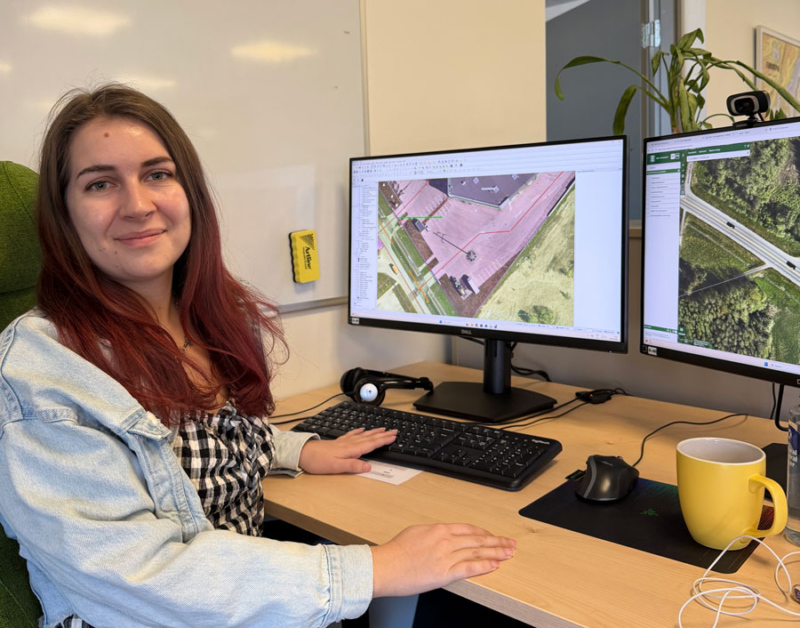
 Lea Sophie Noe